

Table of Contents
Students often use the terms synopsis and summary interchangeably, especially while working on assignments, research papers, or projects. While both involve condensing content, they serve very different purposes in academic writing. Understanding this distinction is essential—not just for exams, but also for writing dissertations, research proposals, and professional documents.
This guide breaks down the difference between synopsis and summary in a clear, practical, and student-friendly way, with examples and real academic context.
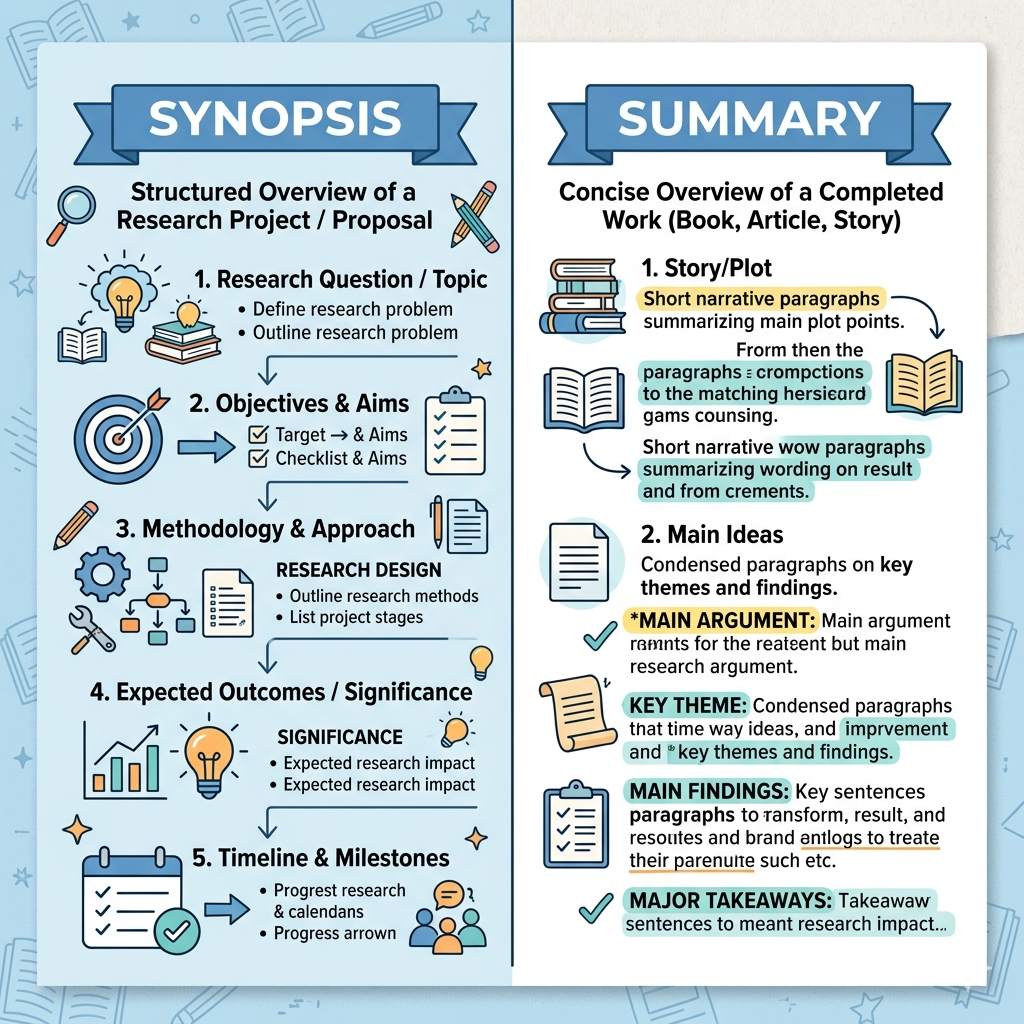
What is a Synopsis?
A synopsis is a structured overview of a larger work. It doesn’t just shorten content—it presents the core idea, structure, purpose, and direction of the original material.
In academic contexts, a synopsis is often used for:
- Research proposals
- Dissertation outlines
- Project submissions
- Book or thesis previews
A synopsis answers key questions:
- What is the topic?
- What is the objective?
- How will the research or content be structured?
- What methods or approach will be used?
Example of a Synopsis
If you are writing a research paper on digital education in India, your synopsis might include:
- Introduction to the topic
- Research objectives
- Methodology
- Expected outcomes
- Chapter outline
So, a synopsis is not just a shorter version—it’s a planned overview with intent and structure.
What is a Summary?
A summary is a concise version of a text that captures its main points without adding new ideas or structure.
It is commonly used in:
- Answer writing
- Note-making
- Reading comprehension
- Article or chapter reviews
A summary focuses on:
- Key arguments
- Main ideas
- Important conclusions
Example of a Summary
If you read a chapter on digital education, your summary would include:
- The importance of online learning
- Key challenges faced in India
- Benefits of technology in education
Unlike a synopsis, a summary does not include methodology, planning, or structure—it simply reduces the original content into a shorter form.
Key Difference Between Synopsis and Summary
Understanding the difference becomes easier when you compare them side by side:
| Basis | Synopsis | Summary |
|---|---|---|
| Purpose | Provides an overview with structure | Condenses key points |
| Usage | Research papers, projects, proposals | Notes, exams, comprehension |
| Content Type | Includes objectives, methodology, outline | Includes main ideas only |
| Length | Slightly detailed | Very concise |
| Approach | Analytical and structured | Simplified and direct |
| Function | Planning + explanation | Reduction of content |
When Should You Use a Synopsis?
A synopsis is required when you need to present your idea before full development. It is especially important in academic and professional settings.
Use a synopsis when:
- Submitting a research proposal
- Writing a dissertation plan
- Pitching a project idea
- Preparing a book outline
In India, universities often require a synopsis before approving a thesis. It acts as a blueprint of your work.
When Should You Use a Summary?
A summary is used when you need to understand or explain existing content quickly.
Use a summary when:
- Studying for exams
- Writing short answers
- Reviewing articles or chapters
- Creating revision notes
Summaries help students retain information effectively and save time during preparation.
Practical Example: Synopsis vs Summary
Let’s take a simple example:
Original Topic:
“Impact of Social Media on Students”
Synopsis Version:
- Introduction to social media usage among students
- Objective: To analyze academic and psychological impact
- Methodology: Survey-based research
- Expected findings: Both positive and negative effects
- Structure: Chapters covering usage patterns, academic impact, mental health
Summary Version:
Social media affects students in both positive and negative ways. It improves communication and access to information but may also lead to distractions and mental health issues.
👉 Notice the difference:
- The synopsis explains what will be done
- The summary explains what is already said

Common Mistakes Students Make
1. Treating Synopsis Like a Summary
Many students write a short paragraph and call it a synopsis. That’s incorrect. A synopsis requires structure and intent.
2. Adding Opinions in Summary
A summary should not include personal opinions—it must stick to original content.
3. Ignoring Structure in Synopsis
A proper synopsis includes:
- Title
- Objective
- Methodology
- Scope
Skipping these makes it incomplete.
4. Writing Too Long Summaries
A summary should be brief. If it feels like a full explanation, it’s no longer a summary.
Why This Difference Matters in Academics
Understanding the difference between synopsis and summary is not just theoretical—it directly impacts your academic performance.
In Exams:
Understanding the Difference Between Synopsis and Summary helps students write more precise and structured answers.
It also saves time and improves clarity, especially during time-bound exams.
In Research:
Knowing the Difference Between Synopsis and Summary is essential in academic research.
A synopsis is often required for approval and helps you organize your work logically before starting the full project.
In Professional Writing:
The Difference Between Synopsis and Summary plays a key role in professional communication.
A synopsis is used in proposals and planning, while a summary is commonly used in reports and briefs.
Mastering the Difference Between Synopsis and Summary Improves:
- Writing clarity
- Critical thinking
- Academic presentation
Pro Tips for Writing a Perfect Summary
A strong grasp of the Difference Between Synopsis and Summary also improves your summary writing skills.
- Read the original text carefully
- Identify key points
- Use your own words
- Keep it short and precise
- Avoid adding examples or explanations

Final Thoughts
The Difference Between Synopsis and Summary may seem subtle at first, but their purpose and application are completely different. One helps you plan and present ideas, while the other helps you compress and understand information.
For students in India, especially those involved in research or higher education, understanding the Difference Between Synopsis and Summary can significantly improve academic performance and writing skills.
FAQs
1. What is the main difference between synopsis and summary?
A synopsis provides a structured overview with objectives and methodology, while a summary simply condenses the main points of existing content.
2. Is a synopsis longer than a summary?
Yes, a synopsis is usually more detailed because it includes structure and planning, whereas a summary is short and concise.
3. Can a synopsis include new ideas?
Yes, a synopsis can include planned ideas, objectives, and methodology. A summary should not include any new information.
4. Where is a synopsis used in academics?
A synopsis is used in research proposals, dissertations, thesis submissions, and project planning.
5. How many words should a summary be?
A summary should be as brief as possible while covering key points—usually 25–30% of the original content length.